In short: graphene is a sheet of carbon atoms arranged in a hexagonal mesh, just one atom thick. It is extremely thin yet strong, conducts electricity and heat very well, and is almost transparent. Because it combines all of these properties in one material, it is starting to be used in batteries, electronics, textiles, coatings and many other fields.
1. What graphene is
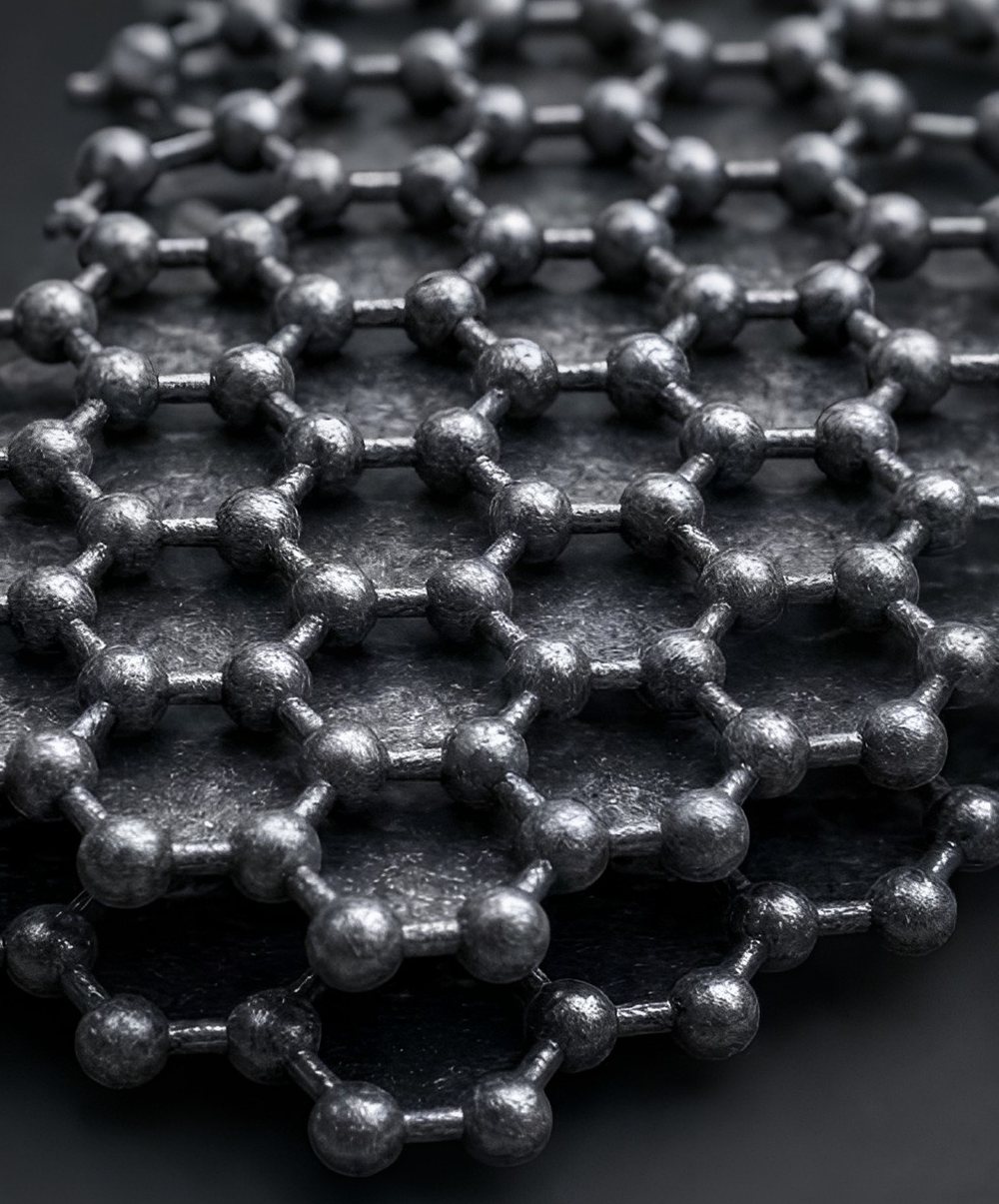
Graphene is a material in which carbon atoms are linked in a hexagonal, honeycomb-like mesh to form a single sheet. It is one carbon atom thick — about 0.3 nanometers, or roughly one three-millionth of a millimeter. It is, quite literally, the thinnest material possible.
Carbon is a common element, found in our bodies, in wood and in paper. Yet the same carbon atoms become entirely different materials depending on how they are arranged. Diamond, the graphite in pencil lead and graphene are all made of carbon alone.
The name combines “graphite” with the suffix “-ene,” used for flat molecules.
2. Graphene and pencil lead
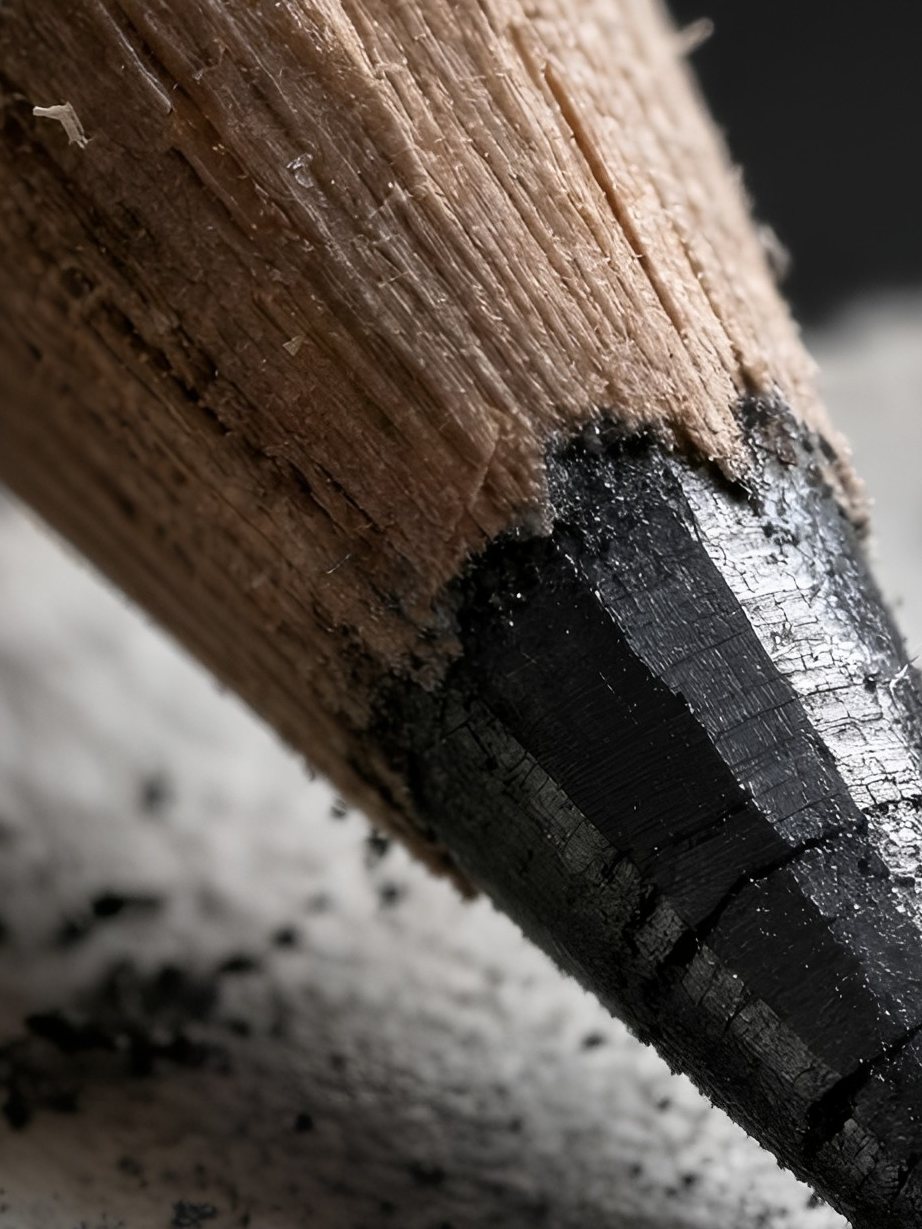
Pencil lead is made of graphite, which is millions of graphene sheets stacked on top of one another. Within each sheet, the carbon atoms are very strongly bonded, but the bonds between sheets are weak. That is why, when you draw a pencil across paper, thin layers peel off and stay on the page.
In other words, every time you write with a pencil, you leave a few stacked layers of graphene on the paper. Graphene is what you get when you isolate just one of those layers. The material was always close at hand — the hard part was separating a single sheet.
In real products, single-layer graphene is used alongside few-layer graphene and graphene nanoplatelets (stacks of about ten or more layers). Because the number of layers changes the properties, the type is chosen to suit the application.
3. What makes it special
Graphene is strong, light, thin, and conducts electricity, heat and light — all at once. Usually, gaining one of these properties means giving up another; graphene combines them in a single sheet.
- Strong: its tensile strength is about 130 gigapascals — around 200 times that of steel of the same weight — yet it is flexible and can be bent.
- Electrically conductive: electrons move through the sheet very fast, so it conducts electricity well. This is used in battery electrodes, electronic components and conductive yarns.
- Thermally conductive: it is among the best heat conductors known, which is why it is used in heat-spreading sheets for smartphones and as a basis for far-infrared-emitting fibers.
- Transparent: a single sheet lets through 97.7% of light. Graphene powder looks black only because many sheets are stacked together.
- Large surface area: in theory, one gram has a surface area of about 2,600 square meters — roughly ten tennis courts.
- Impermeable: the hexagonal mesh is so fine that a perfect sheet blocks even small gas molecules. This is being explored for anti-corrosion coatings and gas-barrier films.
* These are representative values reported in research for a single, defect-free sheet. In real products, performance depends on the number of layers, the production method and the materials it is mixed with.
4. Discovery and the Nobel Prize
Graphene had long been known in theory, but isolating a single sheet was thought to be impossible. In 2004, Professors Andre Geim and Konstantin Novoselov at the University of Manchester succeeded in isolating graphene with a surprisingly simple method: peeling layers off graphite with adhesive tape. They received the 2010 Nobel Prize in Physics for this work.
Some twenty years later, graphene has moved from the laboratory into batteries, heat-management materials, coatings, textiles and cosmetics.
5. How graphene is made
There are several methods, broadly divided into “peeling layers off graphite” (top-down) and “building it up from atoms” (bottom-up). The method determines the quality, quantity and price.
| Method | How it works | Characteristics |
|---|---|---|
| Mechanical exfoliation | Physically peeling layers off graphite, e.g. with tape | Highest quality but tiny quantities. For research |
| Oxidation–reduction (chemical) | Oxidizing graphite with strong acids to separate the layers (graphene oxide), then reducing it | Easy to mass-produce, but oxygen and chemical residues (defects) tend to remain. The most common method on the market |
| Purely physical method | Separating the layers by physical force alone, without chemicals | No strong acids, so few chemical residues and graphene’s intrinsic properties are better preserved. Our method |
| CVD (chemical vapor deposition) | Growing sheets from a carbon-containing gas on a metal substrate | Produces large, uniform sheets for electronics and transparent electrodes. Expensive |
J.C. Technology produces graphene and graphene quantum dots by a purely physical method at its own R&D and manufacturing base in China. Because no strong acids are used, there are no chemical residues, and the carbon purity is 99.9%.
6. Graphene vs. graphene oxide
Graphene oxide (GO) is often mentioned alongside graphene. The names are similar, but the properties are quite different.
| Graphene | Graphene oxide (GO) | Reduced graphene oxide (rGO) | |
|---|---|---|---|
| Structure | A sheet of carbon only | Many oxygen-containing groups attached to the sheet | GO with some of the oxygen removed |
| Electrical conductivity | High | Very low | Conductive, but lower than graphene |
| Dispersion in water | Poor | Good | In between |
| Main uses | Electronics, heat management, textiles, composites | Membranes, coatings, research | Battery materials, conductive coatings |
Graphene oxide is easy to mass-produce and handle, but the oxygen groups act as defects and reduce graphene’s conductivity. Even after reduction, it does not fully return to the original. A product labeled as containing “graphene” may in fact use graphene oxide or reduced graphene oxide, so it is worth checking which material is used.
7. Other carbon materials
| Material | Shape | Main features and uses |
|---|---|---|
| Graphene | Flat sheet (2D) | Thin, strong, conducts electricity and heat. Batteries, heat management, textiles, composites |
| Graphite | Stacked graphene layers (3D) | Pencil lead, battery anodes, lubricants |
| Carbon nanotubes (CNT) | Graphene rolled into a tube (1D) | Thin, strong fibers. Conductive additives, composites. Reported in 1991 by Dr. Sumio Iijima of Japan |
| Fullerenes | Soccer-ball-shaped spheres (0D) | Cosmetics, organic solar-cell research. 1996 Nobel Prize in Chemistry |
| Diamond | Three-dimensional crystal | One of the hardest materials. Poor electrical conductor |
| Carbon black | Fine carbon particles | Tire reinforcement, black pigment |
Graphene is the “basic sheet” of these materials: roll it up and you get a carbon nanotube; stack it and you get graphite.
8. Graphene quantum dots
Graphene quantum dots (GQD) are graphene broken down into nanometer-sized particles — ours are smaller than 5 nm. At this size, properties appear that the flat sheet does not have. Learn more in our guide What are graphene quantum dots? and on our graphene quantum dots business page.
9. Uses of graphene
Graphene is rarely used as a powder on its own. It is mainly added in small amounts to other materials to improve their performance.
Uses across industry
| Field | How it is used | Property used |
|---|---|---|
| Batteries and energy storage | Conductive additive in lithium-ion battery electrodes; supercapacitor electrodes | Conductivity, surface area |
| Heat management | Heat-spreading sheets and coatings for smartphones and computers | Thermal conductivity |
| Semiconductors and electronics | Research on high-speed transistors, sensors, transparent electrodes and flexible substrates | Conductivity, transparency, flexibility |
| Composites | Added to plastics, rubber and concrete for strength and durability (sporting goods, tires, building materials) | Strength, light weight |
| Paints and coatings | Anti-corrosion paints, conductive paints, automotive coatings | Impermeability, conductivity |
| Water treatment | Research on filtration membranes for desalination and water purification | Fine mesh, surface area |
| Textiles | Functional fibers with graphene compounded into the yarn; conductive yarns | Thermal and electrical conductivity |
Where J.C. Technology works
- Textiles
Graphene composite fiber
Graphene compounded into polyester and nylon yarns, for innerwear, bedding, uniforms and workwear. In the Japanese market, these textiles are offered with five functions: antibacterial and odor-resistant, antiviral, anti-mite, anti-mold and far-infrared emission. → Graphene business
- Recovery wear
Graphene-fiber garments
In Japan, our recovery wear is notified as a Class I general medical device (household far-infrared garment for promoting blood circulation). → Recovery wear
- Cosmetics
Graphene quantum dot ingredients
We supply graphene quantum dots as an ingredient for shampoos, body washes and more. → Graphene quantum dots
- Brand
GranovaQ
Our brand for products made with J.C. Technology graphene materials. → About GranovaQ
* Functions and indications above describe how products are offered in the Japanese market. Claims for products sold outside Japan depend on local regulations. Please consult us for each market.
10. Challenges and outlook
- Variation in quality: “graphene” from different methods and suppliers can differ greatly in layer count, size and defects. When comparing performance, check what the material actually is.
- Mass production and cost: methods for producing high-quality graphene cheaply at scale are still being developed. Matching the required quality to the application is the key to practical use.
- Standards: the International Organization for Standardization (ISO) and others are working to align definitions and measurement methods.
Meanwhile, uses in which “adding a little improves performance” — batteries, heat management, composites and textiles — are already reaching the market.
11. Safety
Graphene is made of carbon alone and contains no heavy metals or organic solvents. In our textile products, the graphene is compounded inside the yarn and fixed there, so it does not come off as powder during wear.
When handling graphene powder in factories, ventilation and masks are recommended to avoid inhalation, as with other nanomaterials. If you have questions, please contact us.
12. FAQ
- What is graphene, in simple terms?
- It is a sheet of carbon atoms arranged in a hexagonal mesh, just one atom thick. Think of it as a single layer taken from pencil lead (graphite).
- What is the difference between graphene and graphite?
- Graphite is millions of graphene sheets stacked together. Pencil lead is graphite; a single layer separated from it is graphene. Both are made of carbon, but a single sheet is very different in strength and conductivity.
- What is the difference between graphene and graphene oxide?
- Graphene oxide is a graphene sheet with many oxygen-containing groups attached. It disperses easily in water and is easy to mass-produce, but it barely conducts electricity, so graphene’s intrinsic properties are weakened.
- Who discovered graphene?
- In 2004, Professors Andre Geim and Konstantin Novoselov at the University of Manchester isolated a single sheet from graphite using adhesive tape. They received the 2010 Nobel Prize in Physics.
- What is graphene used for?
- Battery electrodes, heat-spreading sheets for smartphones, reinforcement of plastics and concrete, anti-corrosion paints and functional textiles. Research is also under way in semiconductors, sensors and water-treatment membranes.
- What color is graphene?
- A single sheet is almost transparent (it lets through 97.7% of light). Graphene powder and yarn look black because many sheets are stacked together.
- Is graphene expensive?
- It depends on the method and quality. Large, uniform sheets for electronics are expensive, while graphene powder for textiles and coatings has become affordable through mass production.
- What is the difference between the purely physical method and the oxidation method?
- The oxidation method separates graphite layers with strong acids; it is easy to scale but tends to leave oxygen and chemical residues. The purely physical method separates the layers by physical force alone, leaving few chemical residues and better preserving graphene’s intrinsic properties.
- Can I buy graphene materials or use them in my products?
- Yes. J.C. Technology supplies graphene and graphene quantum dots as raw materials and also provides yarn, fabric and finished products on an OEM or private-label basis. Please contact us with your application and volume. We can communicate in English, Japanese and Chinese.
From graphene to products.
From raw graphene and graphene quantum dots to fibers, recovery wear, cosmetic ingredients and antibacterial films — talk to us about everything from material to finished product.